
A 147c letter is the document that quietly decides whether your US business bank account survives its first compliance review. For a non-US resident who has formed an LLC and obtained an EIN, the IRS confirms that number exactly once — on a CP 575 notice mailed to the address on your Form SS-4. Miss that letter, lose it, or find the entity name on it does not match what your bank has on file, and you hit a wall: Mercury, Relay and Chase all want IRS-issued proof of your EIN before they will open or keep the account. The 147c letter is the official way back. This guide explains what a 147c is, how it differs from the CP 575 that cannot be reissued, why banks insist on one, and the exact phone process a non-resident follows to request it — including which IRS number to call from abroad, how the agent verifies your authority, and how to get the letter delivered by fax the same day rather than waiting weeks for mail.
Mercury — US business banking that accepts CP 575 and 147c from non-resident founders
What a 147c letter actually is
A 147c letter — the IRS calls it Letter 147C, "EIN Previously Assigned" — is an official verification document that confirms two facts: the Employer Identification Number the IRS has on record for your entity, and the exact legal name that EIN is attached to. It is not an application, not a new EIN, and not a tax filing. It is the IRS restating something it already knows, in writing, so that a third party — almost always a bank — can rely on it.
The letter exists to solve a specific problem. When the IRS first assigns an EIN, it generates a confirmation notice called the CP 575 and mails it once to the address on your Form SS-4. For non-residents forming a US LLC, that CP 575 frequently goes astray — mailed to a registered agent who does not forward it, sent to a virtual mailbox the founder had not yet set up to scan, or simply lost in the months between formation and the first bank application. Because the IRS states plainly that the original CP575 series "cannot be duplicated or recreated," there is no way to ask for another CP 575. The 147c is the sanctioned substitute, and the IRS confirms it "can be used as a substitute for the original CP575A-J notice series."
The 147c carries the same weight as the CP 575 at every bank we have tested for non-resident accounts. It shows the entity name and EIN on IRS letterhead, and — critically for founders who filed under a slightly different name than their bank later recorded — it shows the name exactly as the IRS holds it. That makes the 147c the definitive tie-breaker in a name-mismatch dispute, because there is no higher authority on what your EIN's registered name is than the IRS's own record of it.
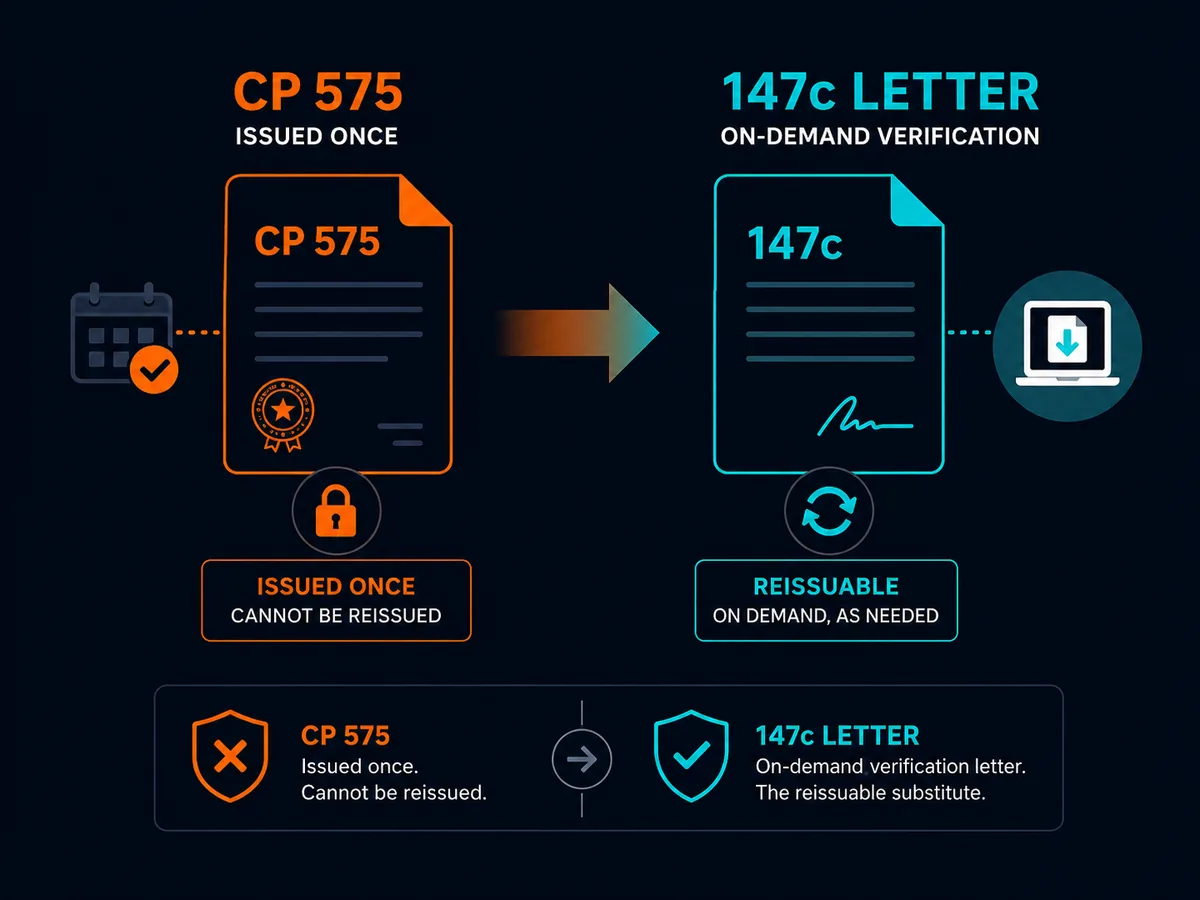
147c versus CP 575 — the difference that matters
The confusion that sends founders in circles is treating the CP 575 and 147c as two names for the same thing. They prove the same fact, but they are produced under completely different circumstances, and understanding the split saves a wasted phone call.
The CP 575 is automatic and one-time. You do not request it — the IRS generates it the moment your EIN is assigned, whether you applied online, by fax, by mail, or by phone. It arrives by post at the address on your SS-4, usually within four weeks of assignment (or immediately as a PDF if you used the online EIN Assistant, a route closed to applicants without a US taxpayer ID, as covered in our EIN for non-US residents guide). It is the birth certificate of your EIN. And like a birth certificate that has been lost, it cannot be reprinted — the IRS keeps no facility to reissue the original notice.
The 147c is on-demand and repeatable. You request it, by phone, any time after the EIN exists. There is no limit on how many times you can ask for one. It reads slightly differently from a CP 575 — it references the EIN as "previously assigned" rather than newly issued — but it carries the same legal weight and the same two data points banks need. Where the CP 575 is a snapshot from the day of assignment, the 147c is a fresh confirmation from the IRS's current records, which is exactly why it resolves name-mismatch questions the aging CP 575 sometimes cannot.
There is now a third option worth noting. The IRS has rolled out a digital CP 575 — an "Employer Identification Number Verification Notice" that eligible users can download from a Business Tax Account, which the IRS says can also substitute for both the original CP575 series and the 147c. In practice, most non-residents cannot yet access a Business Tax Account because it requires an identity-verified login that is difficult to complete without a US credential, so the phone-requested 147c remains the reliable path for foreign founders.
Why banks demand EIN proof — Mercury, Relay, Chase
US banks and fintechs do not ask for a CP 575 or 147c to be difficult. They ask because federal law requires it. Under the Customer Identification Program rules that implement the Bank Secrecy Act, a financial institution opening a business account must collect and verify the customer's taxpayer identification number against a reliable source. For a US entity, that number is the EIN, and the most reliable source is an IRS-issued document stating it. A screenshot of an email, a formation service's internal dashboard, or your own typed statement of the number does not satisfy the requirement; an IRS letter does.
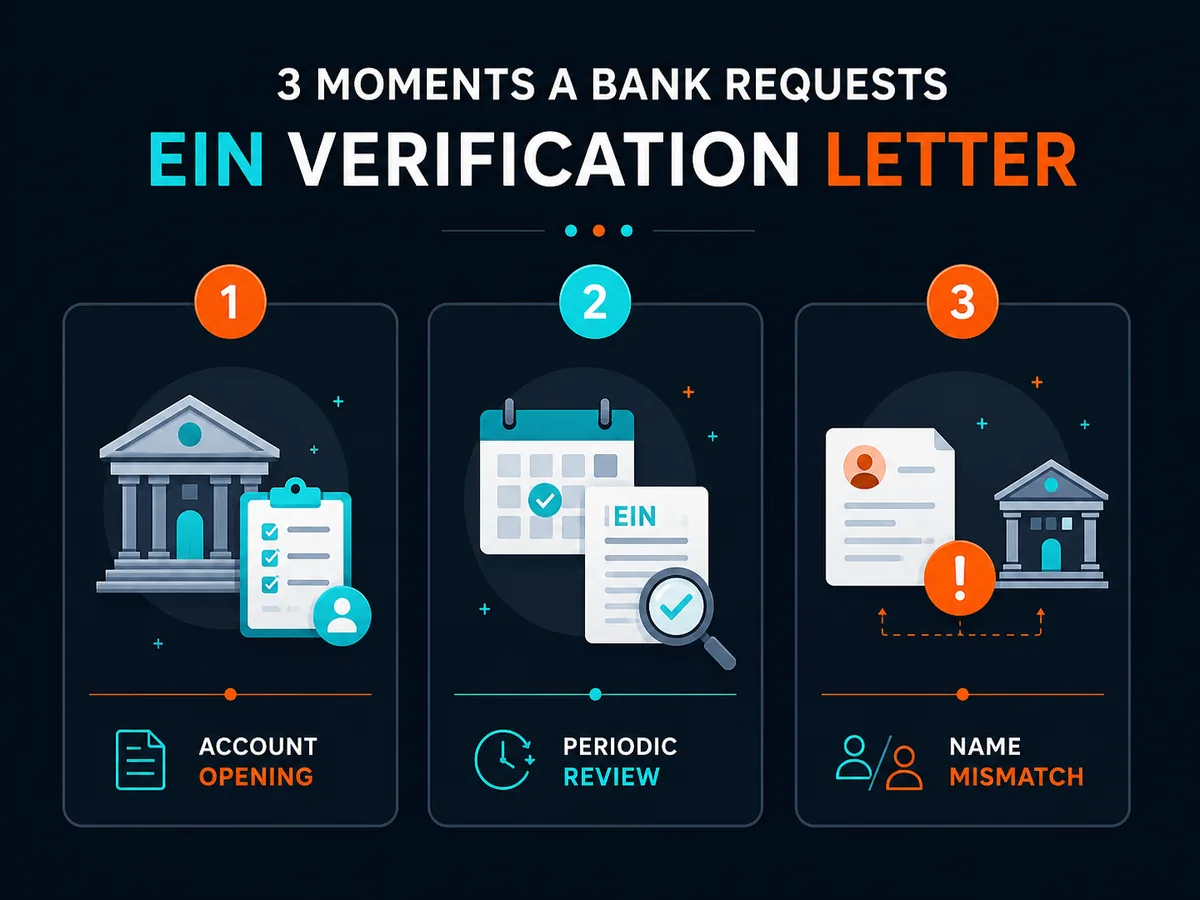
This is why the request appears at three distinct moments. First, at account opening: Mercury, Relay, Brex, Chase and Bank of America all list an EIN confirmation letter among the documents a business must provide, alongside formation papers and beneficial-owner identification. Our guides to the best US business bank accounts for foreign-owned LLCs and the mechanics of opening a company bank account both flag this as a gating document. Second, during periodic review: banks re-verify existing customers, and a compliance analyst comparing your EIN letter to your account records may flag a discrepancy that freezes activity until you supply fresh proof. Third, at name mismatch: if the legal name on your EIN differs — even by a punctuation mark, an "LLC" versus "L.L.C.", or a word order change — from what the bank recorded, the account can be flagged, and a 147c showing the IRS's exact spelling is what clears it.
Mercury and Relay are the two fintechs most non-resident founders reach for, precisely because both accept a clear scan of a CP 575 or 147c without demanding an in-person branch visit. Traditional banks like Chase generally require the founder to appear at a US branch with the physical letter, which is why the fintech route dominates for readers who never set foot in the US. Whichever you choose, the EIN letter is non-negotiable — so if yours has gone missing, the 147c is the thing standing between you and a working account.
When you actually need a 147c
You do not need a 147c if you still have a legible CP 575. Reach for the 147c only in these situations:
You lost or never received the CP 575. The most common case for non-residents. The letter was mailed once, to an address you no longer control or never monitored, and it is gone. Since the original cannot be reissued, the 147c is your only route to an IRS-issued EIN document.
Your bank flagged a name mismatch. You opened the account with one spelling of the entity name and the IRS holds another, or a periodic review surfaced the discrepancy. A 147c shows the IRS's authoritative spelling and settles it.
A new bank, processor or vendor demands independent EIN proof. Opening a second account, onboarding with a payment processor, or registering with a US marketplace can each trigger a fresh request for IRS documentation, and your years-old CP 575 may be somewhere you cannot quickly reach.
You are verifying the exact name before a filing. Founders preparing the annual Form 5472 disclosure for a foreign-owned single-member LLC sometimes request a 147c to confirm the precise legal name the IRS expects on the return, avoiding a mismatch that could complicate processing.
What a 147c does not do is change anything. It cannot correct a wrong name — that requires a separate written request to the IRS to amend the entity record — and it cannot issue a new EIN. It only restates what the IRS already has. If your entity details themselves are wrong, fix those first; the 147c will then reflect the corrected record.
How to request a 147c — the phone process step by step
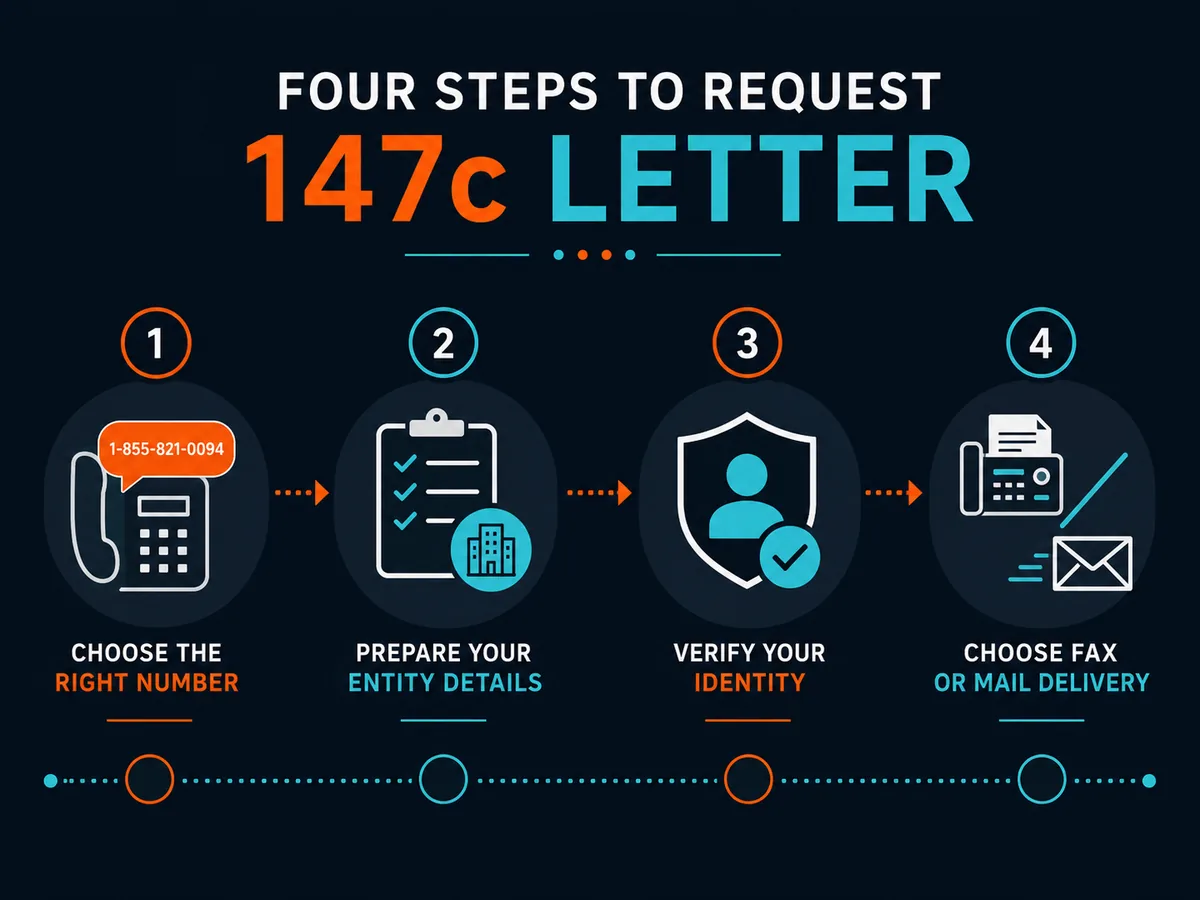
There is exactly one way to request a 147c: by telephone. The IRS does not accept 147c requests online, by email, or through a web form, and no automated system issues them. You call, you prove who you are, and a human agent sends the letter. Here is the process end to end.
Step 1 — Choose the right IRS number
If you are calling from inside the US, dial the IRS Business and Specialty Tax Line at +1-800-829-4933. It is open Monday to Friday, 7am to 7pm local time (residents of Alaska and Hawaii follow Pacific time). This toll-free line handles EIN matters, including 147c requests.
If you are calling from outside the US, the toll-free 800 number will not connect. Use the IRS international line at +1-267-941-1099, open Monday to Friday, 6am to 11pm Eastern Time. This line is not toll-free, so call charges from abroad can be significant — a VoIP service such as Skype, Zoom, or a softphone on a US calling plan keeps the cost near nothing and, as a bonus, gives you a US-format number the IRS system handles cleanly.
Step 2 — Have your entity details ready
Before you dial, open everything the agent will ask you to confirm. You will move faster, and hesitation on identity questions is what gets a call terminated. Have to hand:
- Your EIN (the nine-digit number itself, if you know it — the agent can locate the record from the name if you do not).
- The exact legal name of the entity as filed with the state.
- The entity's US address on file with the IRS.
- Your name and role — responsible party, member, officer or partner.
- The formation state and, ideally, your certificate of formation.
Step 3 — Pass identity verification
The agent's job is to confirm you are entitled to receive EIN information before releasing anything. Expect them to ask whether you are the responsible party named on the original SS-4, or an authorised officer, member or partner of the entity. They will cross-check the entity name, EIN and address against the IRS record. If you are a third party — a formation agent or accountant requesting on a client's behalf — the agent will look for a valid Power of Attorney (Form 2848) or Tax Information Authorization (Form 8821) on file, and will not release the letter without one. A bank cannot make this call for you; only an authorised party of the entity can.
Step 4 — Choose delivery: fax or mail
Once your identity clears and the agent locates the EIN, they confirm it verbally on the spot — write it down and read it back. Then choose how you want the written letter delivered:
- By fax. If you give the agent a fax number, they can fax the 147c to it, often while you are still on the line. This is by far the fastest route — the letter can be in hand within minutes. Non-residents without a physical fax machine use a US virtual fax number from a provider like Fax.Plus, eFax or SRFax (a few dollars for a single month), receiving the fax as a PDF in their inbox.
- By mail. If you decline fax, the IRS mails the 147c to the entity's address of record. Domestically this takes roughly 10 to 14 business days; to an international address, allow several weeks and account for postal reliability. The IRS mails only to the address it already has on file — you cannot redirect it to a new address on the call.
The IRS will not email the 147c under any circumstances, and it never sends tax documents by email. Fax and mail are the only two options. Any site promising to email you a 147c for a fee is not the IRS and should be avoided.
Tips for non-residents calling the IRS
The mechanics are identical for everyone, but the friction of calling a US government line from another time zone is real. A few practical points make the difference between a ten-minute success and a repeated redial.
Set up a US virtual fax number before you call. This single step converts a two-week mail wait into a same-call delivery. Providers issue a US fax number in minutes, and you only need it for one month. Have the number written down so you can read it to the agent without fumbling — the entire speed advantage of the phone route depends on it.
Call inside US business hours from your own time zone. The international line runs 6am to 11pm Eastern Time, which maps to inconvenient hours in Asia and Oceania. Early-afternoon Eastern (roughly 1–3pm ET) tends to have manageable hold times; the first hour after opening is often the shortest queue. Build the time-zone math before you dial rather than discovering the line is closed.
Use VoIP, not a mobile roaming plan. International calls to a non-toll-free US number on a mobile carrier can run into serious money over a 30–45 minute call that includes hold time. Skype, Zoom, Google Voice or any softphone with US calling keeps it trivial and, because it presents a clean US-format connection, avoids call-quality issues that make identity verification harder.
Confirm your address of record is one you can reach. If you are taking mail delivery, the letter goes to the address the IRS holds — often your registered agent or a virtual mailbox. Make sure that address scans and forwards, or that you can retrieve post from it. If your address has changed, the Form 8822-B update should already be filed; the agent cannot send the 147c to a new address on the spot. Our note on US proof of address for non-residents covers keeping this record clean.
Know your entity classification. For a foreign-owned single-member LLC, be ready to state the entity type plainly. Agents move faster when you can answer their structural questions without pause, and any hesitation reads as a red flag on a call whose entire purpose is confirming you control the entity.
The document you should not have needed
The best 147c is the one you never request, because you saved your CP 575 the day it arrived. Founders who use a formation service that bundles the EIN — Doola and Firstbase both handle the SS-4 and return the confirmation as a stored PDF — sidestep the whole problem, because the EIN letter lives in a dashboard rather than a single piece of post that can vanish. If you obtained your EIN yourself, the discipline is simple: the moment the CP 575 arrives, scan it, back it up in two places, and treat it like the passport of your entity.
When the CP 575 is already gone, none of that helps, and the 147c is the clean recovery. It is free, the IRS issues it as many times as you need, and delivered by fax it need not cost you more than an afternoon. Every major non-resident-friendly bank — Mercury, Relay, Wise USD via Wise Business, Payoneer — accepts it as the equivalent of the CP 575 it replaces.
Comparison — CP 575, 147c, and digital CP 575
| Feature | CP 575 | 147c letter | Digital CP 575 |
|---|---|---|---|
| How you get it | Automatic at EIN assignment | Requested by phone | Downloaded from Business Tax Account |
| Reissuable? | No — one time only | Yes — unlimited requests | Yes — while account access lasts |
| Delivery | Mail (or online PDF at assignment) | Fax or mail; never email | Instant download |
| Typical wait | ~4 weeks by mail | Minutes by fax; 10–14 business days by mail | Immediate |
| Accessible to non-residents? | Yes, at assignment | Yes, by phone | Rarely — needs verified US login |
| Accepted by banks | Yes — the original standard | Yes — official substitute | Yes — IRS-stated substitute |
| Cost | Free | Free (plus any call/fax charge) | Free |
Common mistakes and how to avoid them
Asking for a "replacement CP 575." There is no such thing. The original cannot be reissued. Ask specifically for a "147c letter" or "EIN verification letter" and the agent knows exactly what you need.
Expecting an email. The IRS will not email the 147c, full stop. If you have no fax option, you are on the mail timeline. Set up a virtual fax before calling if speed matters.
Calling the wrong number from abroad. The 800 number does not connect from outside the US. Non-residents must use +1-267-941-1099. Dialling the toll-free line from overseas just wastes an attempt.
Not being ready to prove authority. The call fails at identity verification more than anywhere else. Have the entity name, EIN, address and your role ready, and know whether you are the responsible party or need authorisation on file.
Sending a bank to request it for you. A bank cannot obtain your 147c. Only an authorised party of the entity can. Get the letter yourself, then hand the bank the PDF.
Letting the address of record go stale. If the IRS mails to an address you cannot reach, the letter is effectively lost again. Keep the entity address current with Form 8822-B, and prefer fax delivery when you can.
When to consult a qualified professional
Requesting a 147c is a task most founders complete themselves in a single phone call. Where professional help earns its fee is adjacent: correcting a genuinely wrong entity name on the IRS record (a written procedure, not a 147c), untangling a case where two EINs were mistakenly assigned to one entity, or resolving a bank's compliance hold that a 147c alone does not clear. For readers whose 147c need arises from a broader restructuring — adding members, changing the responsible party, or electing corporate treatment — a US CPA with international clients is worth the consultation, because the EIN record is only one thread in the entity's tax posture.
The Soveraine view: request the 147c yourself, take fax delivery, and keep the resulting PDF as carefully as you should have kept the CP 575. It is a free, repeatable safety net — but a safety net you would rather never fall into.
FAQ
What is a 147c letter and who issues it
A 147c letter — formally Letter 147C, "EIN Previously Assigned" — is the IRS document that verifies your existing Employer Identification Number and the exact legal name attached to it. The IRS issues it on request when you have lost or never received your original CP 575 confirmation. Unlike the CP 575, which the IRS mails only once at the moment your EIN is assigned, the 147c can be requested again and again. You obtain it by calling the IRS Business and Specialty Tax Line at +1-800-829-4933, verifying your authority over the entity, and asking the agent to send the letter. Banks accept it as an equivalent to CP 575.
What is the difference between a 147c letter and a CP 575
Both prove the same fact — that a given EIN belongs to a given legal entity — but they differ in when and how you get them. The CP 575 is the one-time confirmation notice the IRS generates automatically when it first assigns your EIN; the IRS states the original CP575 series "cannot be duplicated or recreated," so if you lose it there is no reissue. The 147c is the official substitute: a verification letter the IRS produces on demand whenever you or an authorised party call and ask. Functionally the two are interchangeable for opening a US business bank account. If you still have your CP 575, use it; if you have lost it, request a 147c.
How does a non-US resident request a 147c letter
You call the IRS by phone — there is no online or email option. Residents inside the US call the Business and Specialty Tax Line at +1-800-829-4933, open Monday to Friday, 7am to 7pm local time. Callers from outside the US use the international line at +1-267-941-1099, open Monday to Friday, 6am to 11pm Eastern Time (this line is not toll-free). The agent verifies that you are the responsible party or an authorised officer of the entity, confirms the EIN and legal name on file, and then sends the 147c by fax or mail. Have your EIN, exact entity name, and formation details ready before you dial.
Will the IRS email a 147c letter
No. The IRS does not email 147c letters, and it never sends tax documents or requests for information by email. The only two delivery methods are fax and mail. If an agent locates your EIN during the call, you can ask for the letter to be faxed — often to a US virtual fax number you can set up in minutes — which can arrive during or shortly after the same call. Otherwise the IRS mails it to the address of record for the entity, which takes roughly 10 to 14 business days domestically and longer to an international address. Any website offering to email you a 147c for a fee is not the IRS.
Why do banks like Mercury and Relay demand a 147c or CP 575
US banks and fintechs are bound by Customer Identification Program rules under the Bank Secrecy Act, which require them to verify a business customer's taxpayer identification number against an authoritative source. An IRS-issued CP 575 or 147c is that source — it ties the exact legal name to the EIN in a document the bank can rely on. Mercury, Relay, Chase and Bank of America all ask for one at account opening, and some banks re-request it during periodic reviews if the name on your EIN does not exactly match the name on your formation documents or account. A 147c resolves those name-mismatch queries because it shows the IRS's own record of the entity name.
How long does it take to get a 147c letter
The verification itself happens during the phone call — once the agent confirms your identity and locates the EIN, the record is confirmed verbally on the spot. Delivery of the written letter depends on the method. By fax, it can arrive within minutes of the call if the agent faxes it while you are still on the line. By mail to a US address of record, expect roughly 10 to 14 business days; to an international address, allow several weeks and factor in postal reliability. The phone wait to reach an agent varies by season and time of day — calling early in the local morning generally means shorter hold times.
Can someone else request a 147c on my behalf
Only if they are authorised. The IRS will release EIN information to the responsible party named on the original Form SS-4, to a corporate officer, partner, or LLC member with authority over the entity, or to a third party who holds a valid authorisation on file — a Form 2848 Power of Attorney or Form 8821 Tax Information Authorization. A formation agent or accountant who set up your entity can request the 147c if they have such authorisation. A bank cannot request it for you; you must obtain it and provide it to them. If you name a third-party designee, expect the agent to ask for the authorisation details before releasing anything.
This guide is editorial. We hold affiliate relationships with Mercury, Relay, Doola and Firstbase, disclosed via our affiliate disclosure. Nothing here is tax or legal advice — see our disclaimer.
Ready to act on this?
Mercury — US business banking built for non-resident founders, accepting your CP 575 or 147c without a branch visit. Open an account through our partner link, and you fund independent editorial in the process.
Sources
- IRS — About Form SS-4, Application for Employer Identification Number: https://www.irs.gov/forms-pubs/about-form-ss-4
- IRS — Understanding your CP575 notice: https://www.irs.gov/individuals/understanding-your-cp575-notice
- IRS — Get an employer identification number: https://www.irs.gov/businesses/small-businesses-self-employed/get-an-employer-identification-number
- IRS — Employer identification number: https://www.irs.gov/businesses/employer-identification-number
- IRS — Telephone assistance (Business and Specialty Tax Line, 800-829-4933): https://www.irs.gov/help/telephone-assistance
- IRS — Help with tax questions, International taxpayers: https://www.irs.gov/help/help-with-tax-questions-international-taxpayers
- IRS — Instructions for Form SS-4 (12/2025): https://www.irs.gov/instructions/iss4
- IRS — About Form 2848, Power of Attorney and Declaration of Representative: https://www.irs.gov/forms-pubs/about-form-2848
- IRS — About Form 8822-B, Change of Address or Responsible Party (Business): https://www.irs.gov/forms-pubs/about-form-8822-b
- IRS — 21.7.13 Assigning Employer Identification Numbers (EINs), Internal Revenue Manual: https://www.irs.gov/irm/part21/irm_21-007-013r